Telescope Filters
Filters can dramatically improve what you see through a telescope — but only if you’re using the right one for the right target.
From cutting moon glare to revealing faint nebula structure, this guide explains which filters are worth owning and which ones tend
to sit unused in the case.
When used correctly, astronomical filters can enhance contrast, reduce glare, and isolate specific wavelengths of light emitted by deep-sky objects. However, not all filters provide the same value — especially for visual observers.
One thing observers quickly discover is that not all filters are created equal.
Lower-cost filters can certainly work, but they often have broader or less precise
bandpasses and reduced overall light transmission. This means less contrast and
dimmer views — especially noticeable on faint nebula. Higher-quality filters from
manufacturers like Astronomik, Lumicon, Astrodon, Chroma, TeleVue or Thousand Oaks Optical use tighter wavelength control and
better coatings, allowing more of the desired light through while blocking unwanted
skyglow. The result is a brighter image with improved contrast and more visible
structure. In larger telescopes the difference can be dramatic, but even in modest
apertures a premium filter will usually provide a more pleasing and detailed view.
Below is a breakdown of the most common telescope filters and how we use them in the field.
ND / Moon Filters
Neutral Density (ND), commonly called Moon filters, simply reduce brightness without
altering color. They make lunar observing far more comfortable — especially in larger
telescopes where the Moon can be overwhelmingly bright.
These filters are inexpensive and absolutely worth having if you spend time observing
the Moon.
Color Planetary Filters
Color filters are marketed for enhancing planetary features — reds for Mars, blues for Jupiter, yellows for Saturn, etc.
In practice, we’ve found they rarely get used.
While they can highlight subtle contrast differences, the effect is minor compared to factors like seeing conditions, telescope aperture, and observer experience. Most sets end up spending their lives in the bottom of an accessory case.
Ultra High Contrast (UHC)
The UHC filter is the best all-around deep-sky filter and the one that sees the most
use in our telescopes. It significantly improves contrast on emission nebula by
blocking light pollution while passing key nebular wavelengths.
They provide a dramatic improvement on objects like:
- Orion Nebula (M42)
- Lagoon Nebula (M8)
- Swan Nebula (M17)
- North America Nebula
We regularly use:
- Astronomik UHC
- OPT Triad (designed for imaging but surprisingly effective visually)
The Triad performs very well, but due to its high cost, we don’t recommend purchasing it strictly for visual observing.
Oxygen III (OIII)
OIII filters are more aggressive than UHC and isolate the doubly-ionized oxygen wavelength.
They excel on planetary nebula and supernova remnants, where they can make faint structure stand out dramatically.
A classic example is the Veil Nebula, where an OIII can transform a faint wisp into a highly structured filamentary network.
Filters we commonly use include:
- Astronomik UHC
- 1000 Oaks OIII
Hydrogen Beta (H-Beta)
H-beta is a highly specialized filter that passes a very narrow hydrogen emission line.
It’s primarily used for extremely faint objects such as:
- Horsehead Nebula (B33)
- California Nebula (NGC 1499)
We rarely use this filter, and almost never on smaller telescopes. It typically comes out only on very large aperture instruments — such as our 22" and 25" Dobsonians — where enough light is available for it to be effective.
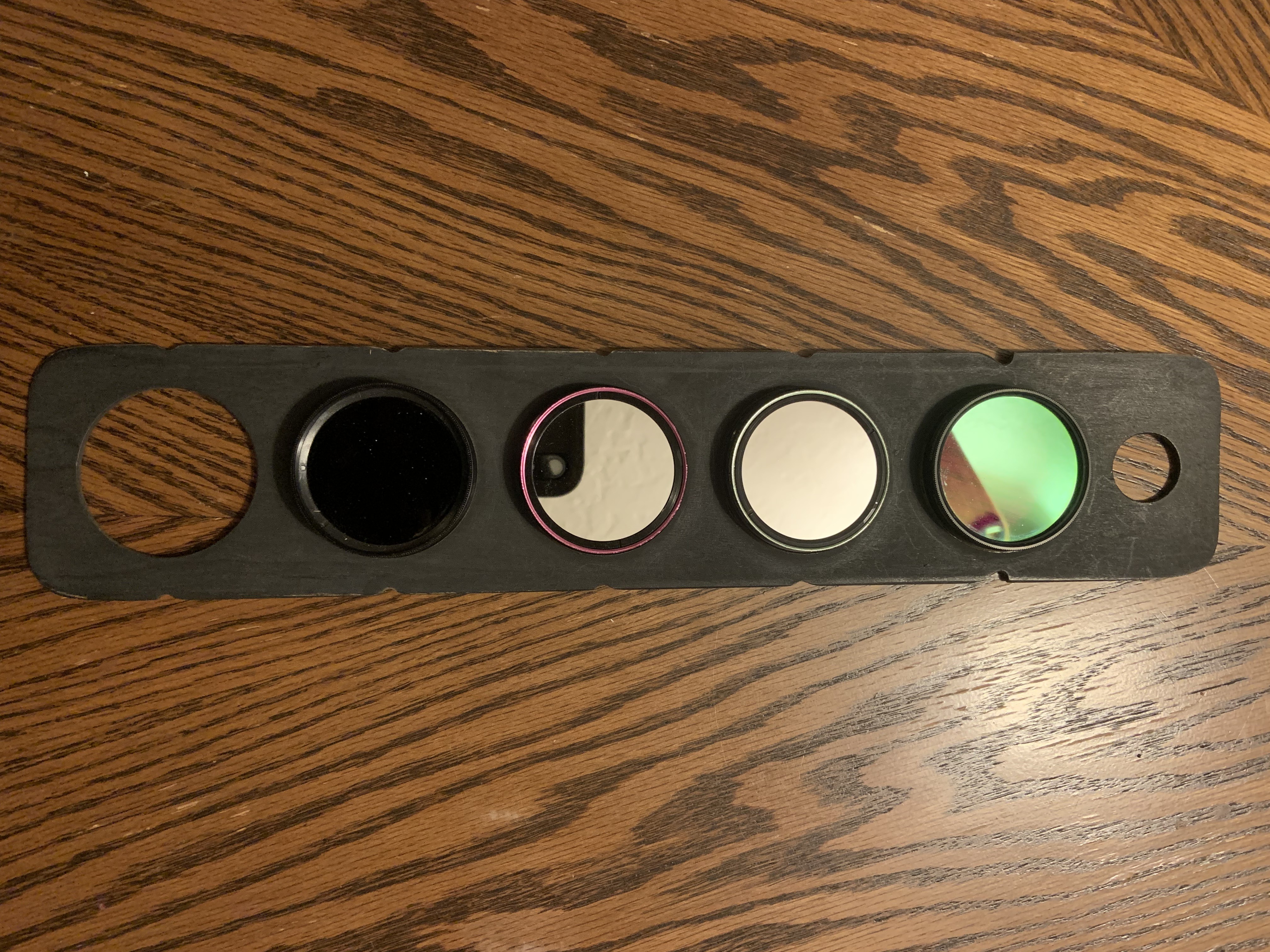
Astrocrumb Filter Slide with Filters
Astrocrumb filter slide loaded with a Moon/ND filter, Astronomik UHC filter, 1000 Oaks OIII filter, and 1000 Oaks Hydrogen-Beta filter. This setup allows observers to quickly switch between filters to enhance lunar detail and bring out faint emission nebula such as the Veil and Horsehead.
Filter Slides (Astrocrumb)
For our large Dobsonian telescopes, we use Astrocrumb filter slides to make switching filters effortless at the eyepiece.
Instead of threading filters on and off in the dark, multiple filters can be mounted in a slide system and changed instantly — a huge advantage during public viewing sessions or when comparing filters on the same object.
Learn more here:
astrocrumb.com